

Ask any liquor store owner what's on their mind heading into 2026 and you'll hear the same themes: Costs are up, customers spend less per visit, and younger shoppers want something different than what their parents bought.
To understand how retailers are responding, we surveyed over 200 independent store owners across 26 states, analyzed anonymized sales data from 1,478 stores, and compiled the findings into our 2026 Liquor Retail Report.
74% of the store owners we surveyed said they're expanding their product selection in 2026.
So, which categories are winning their dollars?
Why Changing Your Liquor Store Product Mix Matters in 2026
First, let’s look at why changing your liquor store product mix matters in 2026.
Our report found that Q4 2025 liquor sales declined 3.3% year over year, with average basket size down 2.2%.
Customers are still coming in, but they’re spending less each visit — and that changes the strategy. Stores can’t rely on volume to protect margins, and simply stocking more of the same products isn’t enough.
Top Liquor Store Products To Expand in 2026
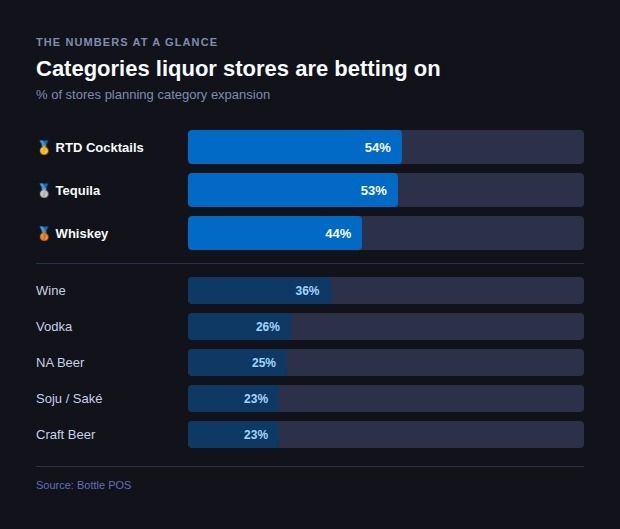
Below is a breakdown of the categories liquor store owners plan to expand and what to consider when planning your shelves.
1. RTD Cocktails
Ready-to-drink (RTD) cocktails were the top pick in our survey, and that matches what many liquor stores are seeing.
RTD beverages have been one of the fastest-growing alcohol segments in recent years, and they’re expected to keep growing globally through 2028.
But convenience is only part of the story.
Many shoppers are willing to pay more for premium RTDs with real spirits, strong branding, and trendy flavors like espresso martinis, ranch waters, and canned margaritas.
How To Sell More RTDs
If you want to sell more RTD cocktails, stop treating them like a side category. Here’s how:
- Give them cooler space.
- Group by occasion or flavor.
- Test premium spirit-based RTDs.
- Rotate seasonal items often.
- Use point of sale (POS) data to remove slow movers quickly.
Related Read: Why Liquor Stores Are Doubling Down on RTD Cocktails in 2026
2. Tequila
Tequila was a close second in our survey and remains one of the strongest growth stories in the category. That momentum could keep building, with experts naming the margarita the top trending alcoholic drink for 2026 in Bacardi’s Cocktail Trends Report.
The category’s long-term outlook is strong, too, with the global tequila market valued at $12.37 billion in 2025 and projected to reach $20.92 billion by 2034.
Tequila in general appeals to a wide range of shoppers, from party planners and cocktail fans to gift buyers and premium sippers.
How To Build a Better Tequila Shelf
Tequila shelves work best when they serve different budgets and occasions, so build them in three tiers:
- Value tier: Blancos and affordable reposados for cocktails
- Mid tier: Popular premium bottles for shoppers trading up
- Top-shelf tier: Anejo and extra-anejo for sipping or gifts
Strong add-on items include margarita mix, salt, tajin, and fresh limes.
3. Whiskey
Whiskey remains one of the most reliable categories in liquor retail.
It has a loyal customer base across bourbon, Irish whiskey, rye, Scotch, and Canadian whisky — and it continues to perform well as both a gifting category and a premium purchase.
But heading into 2026, the opportunity is shifting. It may be less about adding volume and more about refining what’s already on the shelf.
Many liquor stores expanded their bourbon selections during the boom years, and in some cases, that’s led to crowded shelves filled with similar mid-tier bottles and slow-moving SKUs.
How To Clean Up the Category
Run a POS report and look for:
- No sales in 60 to 90 days
- Duplicate price points
- Low-margin slow movers
- Old seasonal buys still sitting
Then, make room for:
- Top-selling premium bourbon
- Irish whiskey growth brands
- Japanese whisky
- Gift packs
- Limited releases
4. Wine
Wine ranked fourth in our survey and remains important, but the category is changing.
With limited shelf space and tighter margins, many retailers are focusing less on expanding selection and more on emphasizing the bottles that consistently perform best at key price points.
How To Sell More Wine
Use POS data to review:
- Bestselling bottles
- Margin by SKU
- Repeat purchase rates
- Slow movers
Then, make the shelves easier to shop with signs like:
- Best under $15
- Smooth reds
- Crisp whites
- Dinner party picks
- Staff favorites
5. Vodka
Vodka ranked fifth in our survey.
It may not be the trendiest category, but it remains one of the most dependable volume categories in many stores. Vodka still performs well for parties, home cocktails, and shoppers who want a familiar option.
How To Find the Opportunity
The better opportunity is not simply adding more mainstream labels.
Look for smarter gaps like:
- Premium imports
- Organic or clean-label vodka
- Popular flavored options
Use local sales data to decide how much space vodka deserves.
Related Read: 6 Essential Products for Your Liquor Store Inventory List
Other Liquor Store Categories To Watch
The remaining categories on our survey list — nonalcoholic (NA) beer, soju and sake, and craft beer — didn't generate the same consensus. But they do represent opportunities depending on your customer base.
Here are a few worth having on your radar:
- NA beer and NA cocktails: 81% of stores we surveyed already carry some nonalcoholic products — but almost all of that is NA beer. NA wine, NA canned cocktails, and functional spirits (adaptogens, botanicals, low-ABV options) are far less represented, which means there's still room to differentiate. The key insight: Most NA drinkers also drink alcohol, so these products aren't a replacement for your core spirits section.
- Soju and sake: Younger consumers and urban markets are driving meaningful interest in these categories. They're not high-volume movers in most markets yet, but the margin per bottle can be strong, and the customer who buys them tends to be a repeat buyer with specific preferences.
- THC and CBD-infused beverages: This was the emerging category that most stood out in our report. Only 3.5% of the stores we surveyed mentioned THC or CBD-infused drinks in their expansion plans. State regulations vary, but stores in markets where these products are available should at a minimum understand what's on the table.
- Craft beer: Craft beer was once a can't-miss differentiator for independent liquor stores. That moment has passed. Only 23% of stores plan to expand here, and the craft beer landscape is saturated enough that standing out requires genuine curation. If craft beer is already a strength for your store, protect it. If not, it probably shouldn't be your focus in 2026.
Get the Full Bottle POS Liquor Retail Report
This blog only scratches the surface.
Behind these category shifts are bigger forces reshaping how customers shop, what drives margin, and how independent liquor stores stay competitive. The retailers who see what's coming will be the ones who act on it first.
Read the full Bottle POS Liquor Retail Report today to get ahead of the curve.