
Limited time offer: Get 75% off when you make the switch or get it for FREE.

1-877-381-4087
1-877-381-4087
Pricing

Liquor Retail 2026: Key Statistics and Trends

A 3.3% drop in year-over-year sales. Basket sizes down 2.2%. Changing demographics, new product offerings, and shifting generational drinking habits.

Liquor stores faced many challenges this year — but they’re rolling with the punches and have a plan to fight back.

We combined anonymized, aggregated industry data from 1,478 liquor stores with survey answers from over 200 store owners to uncover the biggest liquor retail trends in 2026.

transparent (1)

Who We Talked to and
How We Collected Data


201 liquor store owners surveyed 26+ states represented
1,478 stores' aggregated data $103K+ avg. monthly revenue


Average gross monthly revenue of surveyed stores.
$50k–$250k
57.8%
$10k–$50k
28.4%
$250k+
9.8%
< $10k
3.9%

This report combines two data sources: aggregated, anonymized industry trends drawn from 1,478 stores, and direct survey responses from 201 liquor retailers. No individual store data is identified or shared. The goal was to find correlations between industry-wide performance and the strategic choices store owners are making — revealing the psychology behind how retailers are adapting.

The survey

Survey results were collected over two weeks in Q1 2026. These store owners represent a cross-section of U.S. locations and operational sizes, with a primary focus on mid-volume businesses earning between $50K and $250K in monthly gross revenue.

Aggregated industry sales data

Bottle POS processes transactions for thousands of liquor stores nationwide. For this report, we analyzed anonymized, aggregated sales trends across our network — no individual store data is identified or shared. Key metrics include:

Monthly GPV Same-store sales
Transaction counts Average basket size


Liquor Store Profiles

Three Types of Stores.
Three Paths Forward.

Not every store is feeling the same pressures. Our data revealed three distinct profiles based on how owners are responding to 2026's challenges. From margin protection to category expansion.

Find where your store fits.

Cost-Pressured
Cost-Pressured Stores

66% of stores see rising costs as one of the biggest challenges of 2026 — 79% of stores that cited costs as their top concern are doubling down on whiskeys and high-margin bottles to boost profits.

With basket sizes down 2.2%, our analysis shows the most cost-sensitive stores are most likely to stock more high-margin bottles like whiskey (79%), wine (74%), and ready-to-drink (RTD) cocktails (69%) instead of slashing prices.

Recommendations

Focus on premium bottle expansion for higher margin sales

Optimize inventory with data-driven purchasing decisions

Reduce overhead with integrated POS automation

Growth-Oriented
Growth-Oriented Stores

58% of stores believe liquor sales will improve this year and are open to riding new waves — 66% that see RTD cocktails as the biggest industry shift are backing it with shelf space.

RTD cocktails are shifting from a novelty item to a high-margin player, with 54% of stores preparing to expand their stock. Underrepresented zero-proof options like NA canned cocktails, functional spirits, and botanicals are carving a new path for differentiation.

Recommendations

Expand RTD cocktail and NA beverage selection

Target Gen Z with curated premium experiences

Use loyalty programs to increase repeat purchases

Traditional
Traditional Stores

81% of stores already carry NA products, and have done so for years — 18% of stores see craft beer decline and high-quality curation as major trends.

53% of stores are keeping an eye on generational shifts in drinking habits, but nonalcoholic (NA) drinks, especially NA beers (carried by over 80% of stores), aren’t a profit driver. Focusing on novel NA options (wines, cocktails, botanicals) and quality-over-quantity in SKU selection will allow traditional stores thrive in a shifting market.

Recommendations

Curate wine and liquor selections for quality and popularity over quantity

Build local community engagement and loyalty

Plan for succession with documented processes

Survey Highlights

Q4 liquor sales declined 3.3% year over year.

In 2025, our analysis showed stagnant or declining year-over-year sales during liquor stores’ busiest season — but owners remain optimistic about the future.

Cost-pressured stores are going premium, not cheap.

79% of stores expanding into whiskey also cited rising costs as their top concern — the highest of any category. Instead of cutting prices, they're reaching for higher-margin bottles. Our cross-tabulation analysis reveals the strategy behind the shift.

NA is here to stay — but it’s not enough to stand out.

81% of surveyed liquor stores say they already carry nonalcoholic  drinks and have no major plans to expand their selection — but there are still opportunities to stand out.

Rising costs remain the biggest challenge in 2026.

Two-thirds of liquor stores say rising inventory, operations, and living costs are the biggest challenges they face this year. Many are betting on new products and premium bottles.

There’s growing anxiety over generational preferences.

Of the 201 stores we surveyed, 53% noted changing drinking habits of younger generations as a top trend. Novelty products and new NA options are potential key draws.

The popularity of RTD cocktails is booming.

Over half of the surveyed liquor stores plan to capitalize on the popularity of RTD cocktails by expanding their selection this year.

Stores continue to take bets on premium bottles.

Stocking more premium options in traditional liquor categories like tequila and whiskey remains a popular strategy to boost basket size and defend margins.

State of the Liquor Industry: By the Numbers

November 2024 vs. 2025

Total GPV

▼ -3.3%
2024 $180.0M
2025 $173.9M

Transactions

▼ -1.2%
2024 7.05M
2025 6.96M

Avg. Basket

▼ -2.2%
2024 $25.54
2025 $24.99

December 2024 vs. 2025

Total GPV

▼ -0.7%
2024 $210.6M
2025 $209.2M

Transactions

▲ +0.5%
2024 7.45M
2025 7.49M

Avg. Basket

▼ -1.2%
2024 $28.27
2025 $27.94

To understand what's really happening in liquor retail, we analyzed aggregated sales trends from 1,478 stores during the industry's peak season. We focused on Q4, when 70% of store owners say business peaks, to capture the industry at full intensity.

Store owners say they're feeling financial pressure — and industry-wide sales trends confirm it. Our year-over-year comparison of Q4 2024 and 2025 aggregated data puts hard numbers behind what many already suspected.

In November 2025, we recorded $173 million in combined sales across 1,478 liquor stores — down 3.3% from $180 million last year. There were just over 7 million transactions in 2024 to 6.96 million in 2025 — a decrease of 1.2%. Average basket size (transaction volume) also dropped 2.2%.

The year-over-year declines were less drastic in December, a traditionally top-performing month in liquor.

December 2025 sales remained strong, totaling just over $209 million dollars, a less than 1% drop compared to the year before. Unlike November, the year-over-year transactions in December increased by half a percent compared to 2024. Basket size was also down year over year, but the decrease wasn’t nearly as dramatic as the month before.

Overall, these numbers indicate that, while there are lingering concerns, the liquor industry as a whole isn’t in crisis.

However, falling basket sizes remain a consistent challenge, with customers largely spending less per visit. There are several potential causes for this, including a shift towards cheaper products, less risk-averse shopping habits, or a need for stores to adjust product pricing to protect their margins.

How do you expect total liquor sales to perform in 2026 compared to 2025?
Increase significantly
23.27%
Increase slightly
34.59%
Stay about the same
27.04%
Decrease slightly
12.58%
Decrease significantly
2.52%

Sales were down in 2025, but liquor store owners aren’t panicked. Over half of the stores we surveyed (~58%) indicated they expected sales to increase this year. Another 27% expected sales to hold steady, and only 15% of stores we asked thought that sales would continue to decline.

Liquor Sales Trends Over the Years

Liquor Trend Graph FA
Before 2020, the liquor industry was experiencing steady growth. There was a boom during the COVID-19 pandemic, and although sales have plateaued in recent years, this is coming off of a record-breaking industry trend. Since the pop, sales have stabilized, with industry leaders expecting more growth — especially in comparison to pre-pandemic trends — in the years to come.

Adopting New Product Mix Strategies


What product categories do you plan to expand in 2026?
RTD Cocktails 54%
Tequila 53%
Whiskey 44%
Wine 36%
Vodka 26%
NA Beer 25%
Soju/Saké 23%
Craft Beer 23%

When faced with economic uncertainty and industry shifts, many liquor stores adjust their selection in response. As a result, we kept a close eye on the changes they planned to make in 2026.

Of the 201 stores we surveyed, 150 of them indicated they plan to expand their selection in 2026. Results were primarily split between new, novelty options and expansions in staple product categories like spirits and wine. Notably, excitement for craft beer expansion, once a must-have differentiator, has slowed.

RTD cocktails were the strongest consensus pick for product mix changes. 54% of stores planned to carry a wider variety of RTD cocktails (e.g., canned cocktails and premixed bottles) — a strong bet on convenience and premiumization of what was once a novelty item. The wide variety of RTD cocktail styles is also a potential play to please younger generations, who prefer unique flavors over tried-and-true liquor staples like beer and wine.

Despite continued buzz around NA options, liquor stores remain primarily focused on core categories like spirits and wine. Of note, 53% of liquor stores are increasing their selection of tequila, and another 44% said the same about whiskey. These two categories are full of high-margin, premium bottles, showing that stores are willing to invest in quality over quantity.

Going deeper: What cost-pressured stores are actually betting on
79%
74%
69%
65%
62%
Whiskey
Wine
RTD Cocktails
Tequila
NA Beer

Those who cited rising costs as the biggest trend of 2026 were also the most likely to invest in premium bottles as a margin defense strategy — in other words, carrying more expensive bottles to offset higher inventory costs.

Whiskey and wine, two classic staples, led the pack here. These product categories tend to be crowded, with a large number of SKUs fighting for shelf space. Analyzing margins in these categories to phase out middle-of-the-pack or underperforming brands in favor of premium bottles is an effective strategy to drive up margins.

RTD cocktails also seem to be a top choice for stores looking to drive up profit margins in 2026. Despite rising liquor costs overall, many customers seem willing to pay a premium for convenience, which could help boost bottom lines in 2026.

Product expansion plans for stores that cited RTD cocktails as the biggest industry trend of 2026


RTD Cocktails 66%
Tequila 55%
Whiskey 55%
Wine 50%
NA Beer 45%

Two-thirds of retailers who see RTD cocktails as a major industry shift are putting money behind it, with plans to expand their selection in 2026.

Early Signal: 3.5% of Stores Adopting THC and CBD-Infusions

Seven of our 201 respondents (3.5%) mentioned THC and CBD drinks in their product expansion plans. We believe these products are an emerging category worth keeping an eye on.

CBD is already widely popular in the health and wellness market, and THC legalization is gradually spreading to more states (generating tens of billions in revenue). Wellness and alcohol alternative products are also popular drivers among Gen Z.

As regulations evolve, CBD and THC-infused drinks may give liquor stores an exciting opportunity to give customers new experiences and reach younger and “sober curious” customers.


Liquor Report Graphic - Category Sales-1

While there were standouts in our product mix answers, we highly recommend that stores base their selection strategy on their sales data.

Stores should take a close look at their sales by category to understand the types of products that are resonating with customers and achieving the highest margins. This data helps prioritize bottles that are earning their keep and provides a roadmap for phasing out underperforming SKUs.

Looking at profit margins in this data will also determine where it makes sense to stock premium options versus a focus on diversifying into more budget-friendly brands.

Zero-Proof Is Widely Adopted

Reports coming from Wall Street indicate that NA drinks are among the fastest growing products of 2025 and 2026. However, our survey results reveal they’re not a huge focus area for many small and mid-sized liquor businesses.

NA options are largely standard at Main Street liquor stores, with 81% of respondents telling us they already carry some mix of nonalcoholic beer, wine, or spirits. 72% of those stores said they’ve carried NA products for two years or more. 

In other words, simply having an NA selection won’t be enough to stand out from competitors in 2026 — however, there are still profit opportunities in the NA space.

For stores that carry NA products, which types of products do you currently carry?

NA Beer 100%
NA/Low-Alc Wine 78%
NA Spirits 53%
NA Canned Cocktails 44%
Functional Botanicals 29%

Only 41% of the stores we surveyed planned to expand their overall NA selection, and mostly in NA beer. Of the 150 stores planning to increase their product selection, 25% said they would offer more NA beers.

NA beer is certainly the safest bet — the quality and variety of NA beer brands have increased significantly over the last few years. While a safe choice, NA beer is unlikely to be a major differentiator for the average liquor store.

100% of stores that carry nonalcoholic products carry NA beer brands. Standing out from other stores will be much harder in this category. Compared to the 100% saturation of NA beer, newer product categories like NA wine, canned mocktails, and functional spirits were less represented on many of these stores’ shelves.

Zero-proof spirits, mocktails, and botanicals present an opportunity to stand out. Despite 54% of liquor stores telling us they plan to stock more RTD cocktails this year, only 44% of the stores carrying NA drinks are currently selling NA canned cocktails.

Most NA drinkers also drink alcohol, meaning there are ample opportunities to stand out from the competition by offering “sober-curious” NA options alongside popular alcoholic drinks.

Growing Anxiety Over Younger People’s Drinking Habits

Stories about younger people drinking less are everywhere, but the reality isn’t so cut and dry. Some sources report three in five Gen Z adults rarely drink alcohol, or do not drink at all. Others say that Gen Z is starting to drink more.

Drinking is still part of the younger generation’s social life — and despite stories about younger millennials and Gen Z decimating stocks on Wall Street, our data doesn’t show they’re having the same dramatic effect on the average liquor store.
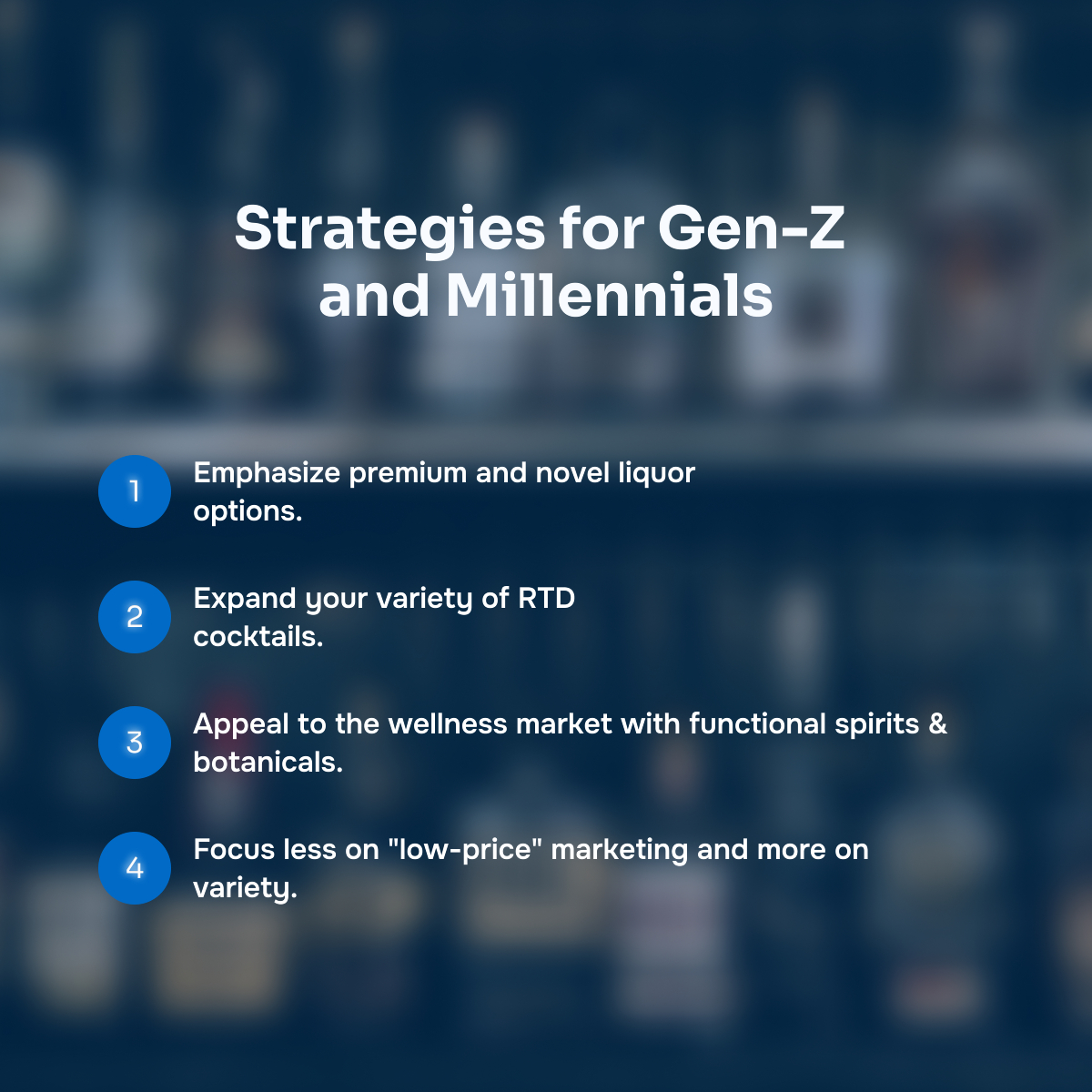
Strategies bpos

The corporate world hasn’t come up with a clear battle plan to tackle millennials' and Gen Z’s changing drinking habits, but many small liquor stores are already trying new tactics.

Younger generations are drinking less to party, opting for quality and novel experiences instead. To capitalize on this, liquor stores should emphasize unique brands, focus on variety, and include wellness and social proof in their marketing.

Get started With Bottle POS

Bottle POS was designed to be smart and simple. Instead of having hundreds of features that liquor store owners won't use, we concentrate on the features that really make a difference.

Desktop
Liquor Retail Image Liquor Retail Open Image

The liquor industry is changing – are you ready?

Get the 2026 Liquor Retail Report

See the latest statistics and emerging trends in liquor retail this year.